
Upper Elementary
(Grades 4-6)
Here, students stretch their curiosity, tackle big ideas, and discover their emerging place in a wider community.
The Upper Elementary program at Sterling Montessori builds upon the foundation laid in the Lower Elementary years. Students ages 9–12 enter a stage of growing moral awareness, reasoning, and abstract thought. They seek a deeper understanding of the world and their role within it.
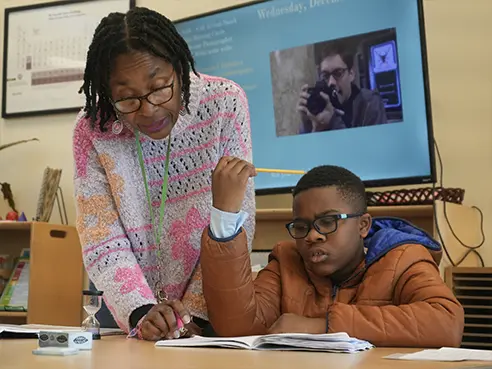
Teachers act as guides and mentors, helping students apply critical thinking skills, take ownership of their learning, and engage in collaborative problem-solving. Lessons often evolve into larger research projects, community engagement, and creative expression.
Grades 4-6 combined in a mixed-age classroom
8:45 am – 3:45 pm
Curriculum
Following Montessori’s Cosmic Education model, all subjects are presented as interrelated and purposeful. The curriculum includes:
- Language Arts: Writing workshops, literature analysis, grammar study, and public speaking
- Mathematics: Advanced operations, fractions, decimals, geometry, and pre-algebra concepts using Montessori materials
- Cultural Studies: In-depth studies of history, geography, and world civilizations
- Science: Life, physical, and earth sciences through exploration and experimentation
- Health Sciences: Human anatomy, wellness, nutrition, and digital citizenship (aligned with NC Standards and the Wonder Years Puberty Curriculum)
- Practical Life: Project management, leadership, and community service
- Peace Education: Positive discipline, restorative justice, and social-emotional growth
Second Plane of Development
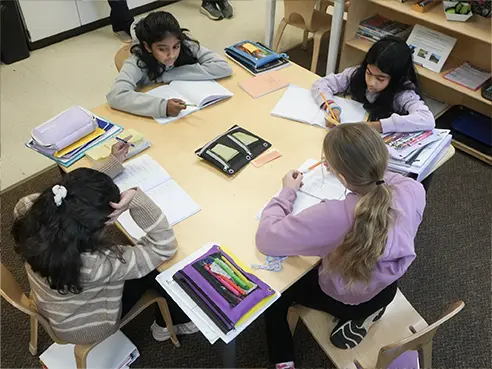
The Upper Elementary classroom supports the needs of children in the latter stage of the second plane of development (ages 9–12), characterized by:
- Developing moral reasoning and emerging leadership
- A transition from concrete to abstract thinking
- A desire for meaningful work and purposeful contribution
- Strengthened collaboration, independence, and self-direction
- Expanding imagination applied to understanding complex ideas and systems
Students in this stage are refining their sense of identity, deepening their social awareness, and building the analytical and interpersonal skills that prepare them for adolescence.

Learn More About Montessori
Explore the principles behind the Montessori method and what they look like in our classrooms. Gain a clearer understanding of how this approach supports children at every stage.
The Sterling Difference
Key Characteristics
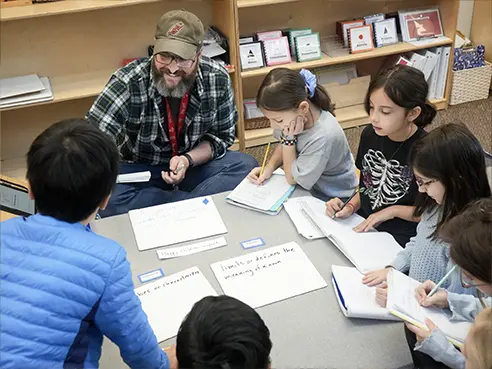
- Grades 4–6 mixed-age classrooms
- 28–30 students per class
- One MACTE-accredited Montessori Lead Teacher and one Assistant
- Integrated curriculum meeting NC Standards
- Hands-on, inquiry-based learning
- Focus on independence, collaboration, and critical thinking
- Specials: Art, Music, and Physical Education
- Spanish instruction for all grades 3–6
Typical Daily Schedule
8:45–11:30 a.m. — Morning Work Cycle
11:30–12:30 p.m. — Lunch/Recess
12:30–3:45 p.m. — Specials / Afternoon Work Cycle
Health & Wellness Program
Upper Elementary students explore the human body systems through scientific study and discussion. The Wonder Years Puberty Curriculum aligns with NC Health Standards, helping students learn about:
- Body systems and how they function together
- Nutrition and wellness
- Digital citizenship
- Healthy relationships and personal safety
Parents are invited to annual curriculum overviews before health units begin.
Resources & Links
Lower Elementary to Upper Elementary Rising Up Presentation
Upper Elementary Language Arts Scope & Sequence
Upper Elementary Math Scope & Sequence
Upper Elementary Science Scope & Sequence
Upper Elementary Social Studies Scope & Sequence
Upper Elementary Health Sciences Curriculum: