
Children’s House and Academy
Our Pre-K Academy invites children to learn by doing—nurturing curiosity, focus, and independence during the most formative years of their development.
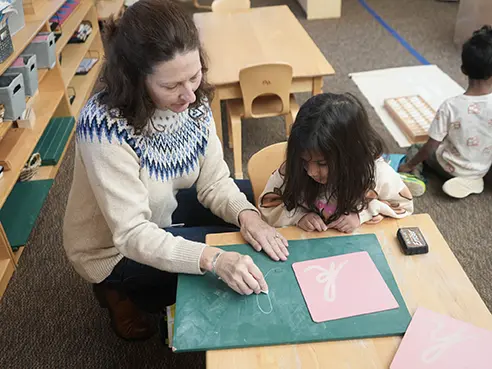 Sterling Montessori’s Children’s House serves as the heart of our early learning program. It brings together our tuition-based Academy (PreK3–PreK4) and public Charter Kindergarten (age 5) into one integrated, mixed-age Montessori environment.
In this foundational stage, children experience the joy of discovery, independence, and community in a setting designed especially for them. The Children’s House is where lifelong learning begins.
Sterling is comprised of two separate educational entities. The Academy serves children 3 and 4 years of age, and is a tuition-based, pre-school program. Academy students are joined with the Charter Kindergarten students in a mixed-aged Children’s House classroom.
Ages
3 – 4 Years Old
8:30 am – 3:45 pm
15:1
The Academy (PreK3 & PreK4)
Tuition-based Pre-K Program
Sterling Montessori Academy serves children ages 3 and 4 in a tuition-based, Montessori preschool. Our Academy students learn alongside our Charter Kindergarten students in the same classroom, forming a vibrant community of learners aged three to six.
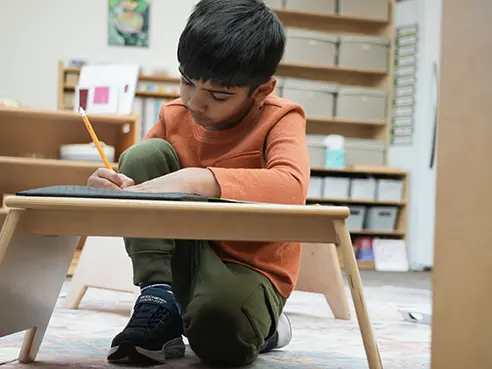 The Montessori classroom is intentionally multi-aged, allowing younger children to observe and learn from older peers while older children develop leadership and empathy. Each classroom is led by a Montessori-certified Lead Teacher and a trained Assistant Teacher, who work together to guide every child through their unique stages of growth.
While Academy students and Charter students learn together, please note that enrollment in our private Preschool Academy does not guarantee a spot in our Charter Kindergarten program. Families must apply through the public Charter School Lottery process.
Preschool is a powerful stepping stone for a child’s educational journey. Using hands-on Montessori materials, children learn to think critically, make purposeful choices, and act with care—all through play, exploration, and guided lessons that prepare them for kindergarten and beyond.
To learn more about the Academy Enrollment Process, including program details, readiness checklist, tuition information, and campus tour options, visit our Academy Enrollment Page.
Together, the Academy and Charter Kindergarten Form Our Children’s House Community.
The Children’s House represents the essence of Montessori learning at Sterling—where children build confidence, independence, and a love of learning that lasts a lifetime.
Curriculum
Within the Children’s House, five distinct curricular areas make up the prepared environment. Each area supports different aspects of a child’s development and integrates seamlessly into a whole-child learning experience.
Practical Life
Children learn to care for themselves and their environment—pouring, sweeping, buttoning, tying shoes, setting the table, and watering plants. These activities strengthen fine motor coordination, order, and independence while building confidence and focus.
Sensorial
Through materials that isolate and refine the senses, children learn to classify and describe the world around them—by color, shape, sound, texture, and size. These activities develop observation, reasoning, and the foundations of mathematical and scientific thinking.
Mathematics
Hands-on materials help children understand abstract math concepts through concrete exploration. From counting and quantity to operations and the decimal system, Montessori math provides a deep, intuitive grasp of number relationships.
Language Arts
Children progress from oral language and vocabulary to reading and writing through tactile experiences like tracing Sandpaper Letters and composing words with the Moveable Alphabet. They also develop handwriting, grammar, and a love for literature.
Cultural Studies
Through geography, history, science, art, music, and movement, children learn about the interconnectedness of people and the planet. Cultural lessons include botany, zoology, and world geography, fostering appreciation for diversity and peace education—core tenets of Montessori philosophy.
First Plane of Development
The Children’s House classroom supports the needs of children in the first plane of development (ages 3–6), characterized by:
- An absorbent mind eager to take in the world
- Rapid growth in language, movement, and sensory exploration
- A deep drive for independence and purposeful work
- The development of concentration and order
Students in this stage are building the foundations of who they are—gaining confidence, refining skills, and forming the early habits that empower lifelong learning.

Learn More About Montessori
Explore the principles behind the Montessori method and what they look like in our classrooms. Gain a clearer understanding of how this approach supports children at every stage.
The Sterling Difference
What is the Children’s House?
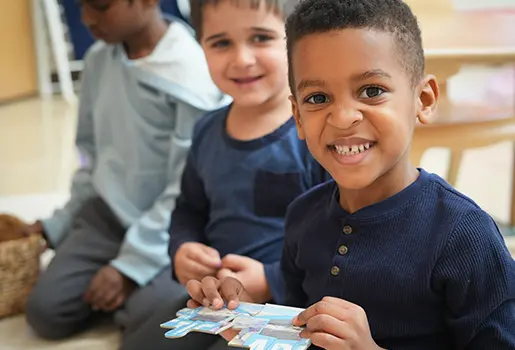
The Space
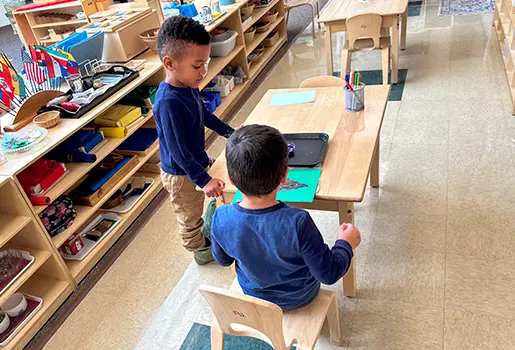
At Sterling, our Children’s House classrooms continue Dr. Maria Montessori’s legacy. Each child learns at their own rhythm in a calm, organized, and beautiful environment where every object has purpose and meaning.
All furniture is child-sized, materials are accessible, and the daily routine offers security and consistency. The environment is carefully prepared to foster:
- Independence and responsibility
- Concentration and coordination
- A sense of beauty and order
- Respect for self, others, and the environment
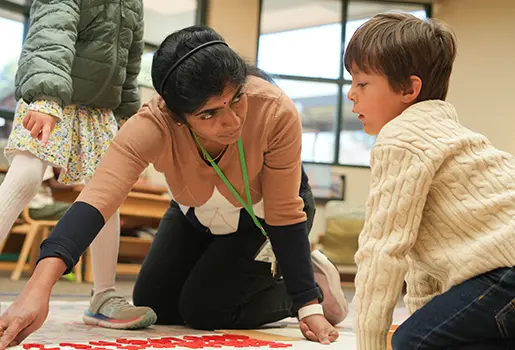
The Learning Community
In a Montessori Children’s House, the classroom functions as a true learning community, where mixed ages allow children to learn with and from one another. Younger students are inspired by the work and confidence of older peers, while older students strengthen their understanding by helping those who are still mastering new skills. This natural collaboration builds empathy, patience, and a strong sense of belonging.
Teachers serve as guides rather than lecturers—observing each child, introducing materials at the right moment, and supporting independence rather than directing every step. Together, this structure creates a harmonious environment where children develop social awareness, leadership, and the confidence to take ownership of their learning.
The Approach
Each day follows a predictable routine that builds confidence and reduces stress. In this setting, children experience the freedom to explore, the joy of success, and the security of belonging.
This is what we mean when we say:
This is a place where one feels secure and at ease.
This is a place that fosters independence.
This is a place that reveals success.
This is a Children’s House.

Kindergarten: A Montessori Milestone
Kindergarten marks the culmination of the Children’s House experience and the bridge to elementary education. As the “elders” of the classroom, Kindergarteners solidify academic skills, strengthen social awareness, and develop leadership by modeling behaviors for younger classmates.
Through continued work with Montessori materials, Kindergarten students move from concrete exploration to abstract thinking, developing problem-solving skills, independence, and self-motivation. Teachers support this growth with individualized lessons, fostering confidence and curiosity as children prepare to “rise up” to elementary.
Resources and Links
Children’s House Scope & Sequence
NC Child Day Care Law & Rules